What High-Spec Homeowners Usually Want
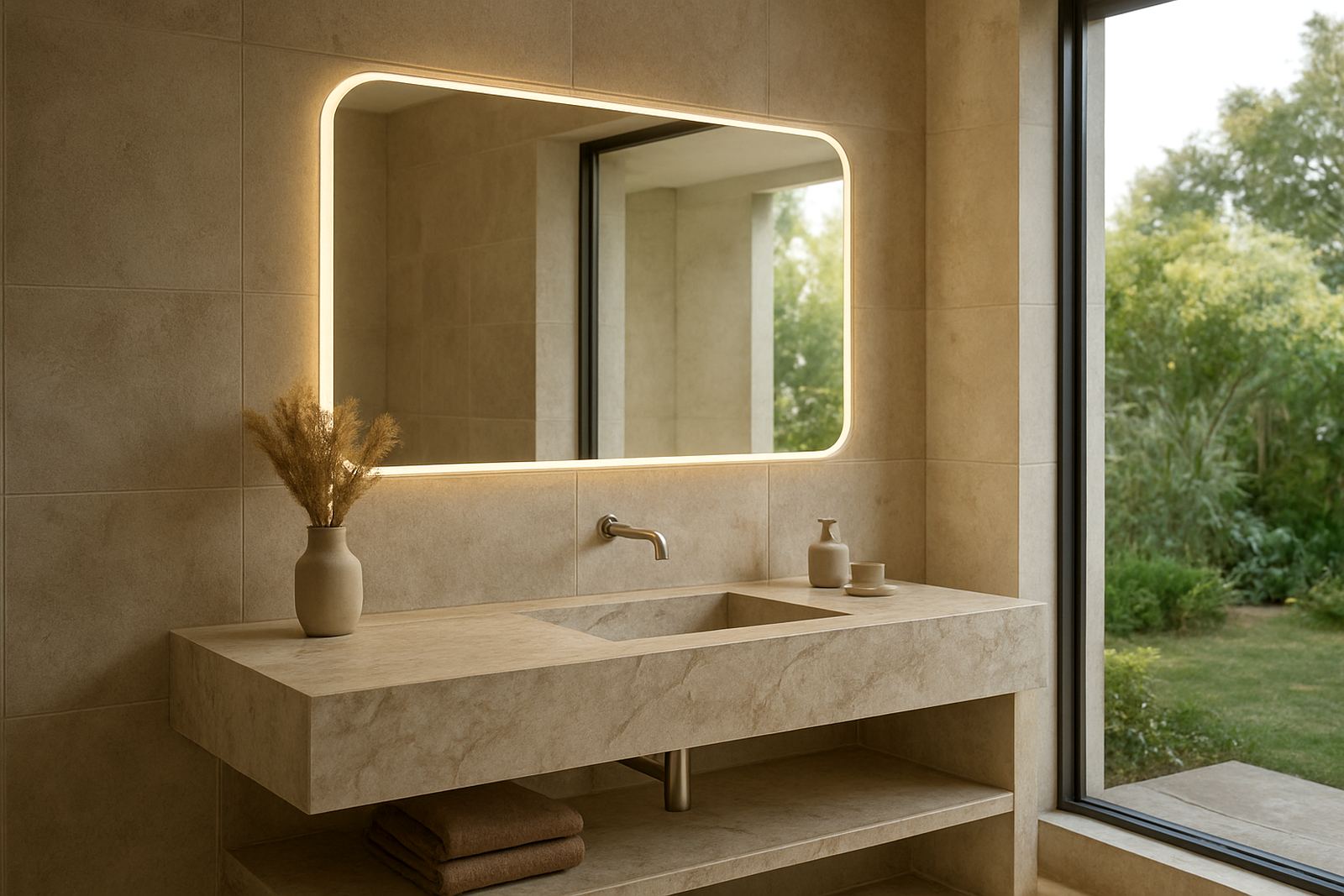
In upmarket homes across Pinetown, Durban North, Umhlanga, Ballito, Hillcrest and Westville, mirror choices are usually tied to the rest of the bathroom scheme. Clients want the mirror to match the vanity width, sit true to the tile lines, and provide even front light without harsh shadows. In many cases the brief also includes demisting, softer night lighting, and a shape that complements stone, timber or matte black fittings.
Most luxury installs start with a site measure so the mirror can be made to suit the wall, the basin layout and the available electrical point. This matters in bathrooms where the vanity is centred off the wall, the window has to stay clear, or the room has been built around a feature bath. A good result looks intentional, not added later.
- Frameless or slim framed LED mirrors for modern bathrooms
- Round, arch and rectangular shapes for master suites and guest suites
- Integrated demister pads for steamy coastal homes
- Touch controls or wall switching depending on the room setup
- Warm white, neutral white or adjustable colour temperature where specified
Typical Equipment Set For A Luxury Bathroom
For most premium homes, the core equipment set is fairly straightforward, but the detail is where the finish changes. A mirror can be supplied as a single statement piece above a double vanity, or as matching mirrors for a main bathroom, dressing room and guest suite. Where the home is near the coast, better sealing and sensible placement are important because humidity can shorten the life of cheaper components.
We often work with builders, interior designers and homeowners who want the mirror to feel like part of the room design, not a separate item. That usually means checking the wall build-up, tile thickness, fixing points and where the cable will enter. If the bathroom has load-shedding backup lighting, the mirror can still be planned so it works safely and does not overdraw the circuit.
- LED mirror in the required size, often 600 mm to 1800 mm wide
- Demister pad for clear visibility after showers
- Touch switch or external switch connection
- Suitable wall fixings and mounting hardware
- Electrical connection by a competent installer
For larger homes, some clients also ask for a coordinated set across the dressing area and the main ensuite, which keeps the home consistent and makes aftercare easier.
Planning The Layout So The Room Feels Balanced
Good planning starts with the vanity and basin position, then the mirror height follows from there. The top edge should not sit so high that it feels detached from the basin, and the lower edge must clear taps, splashback details and any stone upstands. In a luxury home, even a 10 mm error can be visible once the room is tiled and painted.
We recommend allowing for the full mirror depth and any lighting effect on the wall. Some mirrors cast a halo around the edge, while others are designed for direct facial lighting. If the bathroom has dark tiles, glossy surfaces or a feature wall, the light output should be chosen carefully so the reflection is flattering but not glaring.
- Measure after vanities, tiles and mirrors backing surfaces are finalised
- Confirm exact centre lines with the basin and tap position
- Check the electrical point location before ordering the mirror
- Allow for door swings, shaving cabinet doors and towel rail positions
- In coastal homes, keep ventilation in mind to reduce moisture build-up
For homes in areas like Umhlanga and Ballito, we often suggest planning the mirror with slightly more attention to condensation control, since sea air and everyday steam can work together and cause early wear if the room is poorly ventilated.
Common Mistakes In Premium Bathroom Fit-Outs
Luxury bathrooms are often let down by small avoidable issues. The most common one is ordering a mirror before the final measurements are taken. Another is assuming that any electrician can connect the unit without checking the load and switching arrangement. If the power point ends up behind the mirror in the wrong place, the finish can look untidy and the installation becomes harder than it should be.
Another mistake is choosing size by eye alone. A mirror that is too narrow can make a large vanity look under-scaled, while one that is too tall can crowd lights or ceilings. The same applies to the light tone. In homes with warm timber and stone, a very cool light can make the room feel harsh. In bathrooms with bright white finishes, a dull light can leave the space looking flat.
- Ordering before the tiling and vanity heights are confirmed
- Ignoring the position of cables, switches and isolators
- Choosing the wrong light colour for the room finishes
- Leaving no allowance for demisting or humidity exposure
- Trying to fit a mirror that is too large for the wall or access route
When the brief includes a custom shape or a large mirror for a master suite, access through the house and stairwells should also be checked. It sounds simple but tight passages and finished walls can turn a straightforward job into a damage risk.
Budget Ranges For Luxury Home Projects
For luxury homes, the budget depends on size, shape, lighting features and the amount of site work needed. As a guide, smaller premium LED mirrors for powder rooms or guest bathrooms may start from around R4 500 to R8 500 supplied and fitted, while larger feature mirrors for master bathrooms can range from R9 000 to R22 000 or more. Very large bespoke pieces, or matched sets across several rooms, can sit higher depending on electrical work and custom design requirements.
If the mirror needs re-routing of wiring, extra mounting support or a replacement of an older unit, that can add to the cost. Demister servicing and LED component repairs are also common in homes that want to extend the life of an existing mirror rather than replace the full unit. For developers and interior design projects, bulk supply can help keep the per-unit cost under control, especially when the same specification is repeated across several bathrooms.
We always advise clients to budget for the whole installation, not just the mirror itself. That means allowing for site measurement, delivery, connection and any follow-up adjustments. In high-end homes, it is better to get the detailing right once than to redo a wall after paint and stonework are complete.
Why Durban Homeowners Call Us For The Finish
Our Pinetown base makes it practical to support luxury homes across Durban and beyond, with installations handled by a team that understands both the technical side and the visual finish. Sibusiso Nxumalo leads the business, with Ayesha Naidoo on sales, Lungile Mthembu coordinating operations, Johan van Rensburg leading installation, Nokuthula Dlamini handling design guidance, and Calvin Petersen on technical support. That mix helps keep communication clear from measure-up to aftercare.
We work on site measurements, mirror installation, electrical connection, vanity upgrades, mirror replacement, LED component repairs, demister servicing, custom design help, bulk project supply and aftercare support. For homeowners, that usually means one point of contact and a result that feels properly planned. For interior designers, it means the mirror can be coordinated with the broader scheme without last-minute surprises.
Clients in Durban North, Umhlanga, Ballito, Hillcrest, Westville and Pinetown often contact us when they want a bathroom that feels calm, precise and ready for everyday use. That may sound simple, but a good mirror solution can quietly lift the whole room, especially when the rest of the home has already been finished to a high standard.